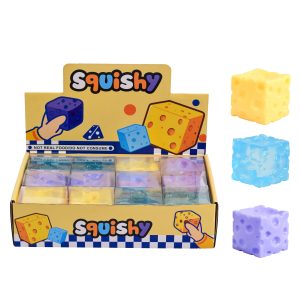
Add a playful twist to sensory exploration with the Squishy Maltose 6cm Cheese Block! Designed to resemble a miniature block of Swiss cheese, complete with distinctive holes, this novelty squishy offers a satisfying tactile experience in a compact, easy-to-hold design.
Made for squeezing and pressing, its soft, maltose-inspired texture provides a dense, slow-rising feel. After being gently squeezed, the cheese block gradually returns to its original shape, making it an engaging option for fidget play and sensory exploration.
Its small size makes it easy to carry in a bag or keep on a desk for convenient access during supervised sensory activities. The fun cheese design also makes it a quirky addition to a squishy toy collection or a playful gift for novelty toy enthusiasts.
Features:
- Miniature Swiss cheese block design with realistic-looking holes
- Compact 6 cm size for easy handling
- Soft, maltose-inspired texture
- Slow-rising effect after squeezing
- Encourages tactile and sensory exploration
- Provides opportunities for fidget play and hand engagement
- Supports fine motor practice through squeezing and pressing
- Lightweight and portable for play at home or on the go
- Available in assorted colours; selection may vary
The Squishy Maltose 6cm Cheese Block combines a fun food-inspired design with satisfying tactile play, making it a delightful addition to sensory activities and squishy toy collections.
Safety Note: This toy is not edible. Avoid biting, overstretching or squeezing it excessively, as the outer material may tear or leak. Adult supervision is recommended, particularly for younger children. Keep away from children under 3 years if small parts present a choking hazard.
EYLF Learning Outcomes:
- Outcome 1 Children can make choices about how they explore the cheese block, express their preferences and build confidence through independent and imaginative play.
- Outcome 2 Children can include the cheese block in shared pretend-play activities, such as running a grocery shop or preparing a pretend meal, encouraging cooperation and positive relationships.
- Outcome 3 Squeezing and handling the soft, squishy toy provides tactile sensory experiences and opportunities to explore relaxation and sensory awareness.
- Outcome 4 Children can explore the toy’s texture, shape and response to pressure, encouraging curiosity, experimentation and problem-solving through hands-on play.
- Outcome 5 Children can describe the cheese block using words such as soft, squishy and smooth, develop descriptive vocabulary and create stories during pretend play.
MTOP Learning Outcomes:
- Outcome 1 Children can make independent choices, express their interests and develop confidence while exploring the toy in their own way.
- Outcome 2 Shared pretend-play activities encourage children to cooperate, take turns, share ideas and build positive relationships with peers.
- Outcome 3 The squishy texture offers opportunities for sensory exploration and relaxation, allowing children to discover activities they find enjoyable and calming.
- Outcome 4 Children can use the cheese block in imaginative scenarios, explore its physical properties and develop creativity, curiosity and problem-solving skills.
- Outcome 5 Children can describe the toy, learn food-related vocabulary, create pretend shopping or cooking scenarios and communicate their ideas with others.
Developmental Milestones:
3–5 Years
- Explores the soft, squishy texture, practises grasping and squeezing, develops descriptive vocabulary and incorporates the toy into simple pretend-play scenarios, such as a kitchen or grocery shop.
6–8 Years
- Practises fine motor coordination, expands descriptive language, develops imaginative storytelling and explores sharing and turn-taking during food-themed role play.
9–12 Years
- Uses creative thinking to develop more detailed pretend scenarios, strengthens communication and cooperative play skills, and explores problem-solving through imaginative activities.
13–15 Years
- Can use the squishy toy for creative expression, sensory exploration and humorous or imaginative play, according to personal interests and preferences.
Links to Theorists:
- This learning experience can be linked to Jean Piaget’s theories:
- Children can explore the cheese block’s texture, shape and response to pressure, encouraging curiosity, hands-on discovery and early problem-solving through play.
- This learning experience can be linked to Lev Vygotsky’s theories:
- Educators and peers can encourage children to describe the toy, learn food-related vocabulary and create pretend grocery-shopping or cooking scenarios together.
- This learning experience can be linked to Maria Montessori’s theories:
- Handling and gently squeezing the squishy cheese block provides opportunities for tactile exploration, sensory awareness and practising hand movements.
- This learning experience can be linked to Friedrich Froebel’s theories:
- Children can incorporate the toy into pretend kitchens, cafés, grocery stores and imaginative storytelling, supporting creativity and self-expression.
- This learning experience can be linked to Albert Bandura’s theories:
- Children can observe others demonstrating imaginative play, sharing and turn-taking, then practise these behaviours during shared activities.
Learning Through Play:
- The Squishy Maltose 6cm Cheese Block provides children with engaging sensory experiences that support learning through play. Its soft, squeezable texture encourages tactile exploration, helping children practise fine motor skills, hand coordination and sensory awareness while enjoying hands-on activities.
- Children can incorporate the toy into imaginative scenarios such as pretend kitchens, cafés, grocery stores, picnics and food-themed role play. These experiences encourage creativity, communication, problem-solving and social interaction while helping children make connections between play and everyday life.
- The squishy cheese block can also provide opportunities for sensory exploration, relaxation and self-expression, depending on each child’s preferences. Children can enjoy independent play or participate in group activities that encourage sharing, turn-taking, cooperation and positive peer relationships.


Reviews
There are no reviews yet.